1785 to 1970
What it became
A school was promised to restore the Mohawk, not to remove the Mohawk from their children. The Nation holds the two side by side: the promise, and what was done under its name.
From Book VIII, The School, its sections on the promise, the buildings and what it became.
Checked against Book VIII on 21 November 2026 · about 7 minutes to read
the second of the three
The promise
The Loyalist Mohawk were promised, on the Grand River, to be restored to the state they were in before the war: a church to keep the faith, a school to learn, a mill for an economy. This is the school.
The first school was Joseph Brant’s idea. He had been schooled himself in Connecticut, learning English while teaching Mohawk to the English boys beside him, and he wanted the same for his people: a school by the chapel at the Mohawk Village where Mohawk children would learn the newcomers’ letters without losing their own. A schoolmaster was kept at the village from the 1780s. What it became was not his idea.
“A school was promised to restore the Mohawk, not to remove the Mohawk from their children.”
Book VIII, The School, the promise
side by side
Promised, and given
What was promised
A school by the chapel, where Mohawk children would learn the newcomers’ letters without losing their own: Brant’s wish, and a schoolmaster at the village from the 1780s.
What was given
A residential school that kept children from Six Nations, from the Grand River and from further away from their families, their language and their ways, for one hundred and thirty-nine years. Survivors describe hunger, labour, punishment and the forbidding of their own language.
1828 to 1970
The buildings
The New England Company, a missionary society of London, opened a day school for boys, the Mechanics’ Institute, in 1828. It took boys as boarders from 1831 and girls from 1834, and so became a residential school: the oldest in what became Canada, and the longest to run.
The buildings burned more than once. The red-brick building that stands today on Mohawk Street was built in 1904 after the second great fire, which by the account of those who have studied it was most likely set by students protesting their treatment. A low school building was added in the 1950s.
| Year | The record |
|---|---|
| 1780s | A schoolmaster at the Mohawk Village, at Brant’s wish |
| 1828 | The New England Company’s Mechanics’ Institute, a day school for boys |
| 1831 | Boys taken as boarders |
| 1834 | Girls admitted |
| 1904 | The brick building, after a fire |
| 1922 | The Government of Canada takes over its management; the Company keeps ownership; the principal to be Anglican |
| 1950s | A low school building added |
| 27 June 1970 | Closed |
on one line
The years
How to read the drawing: the school’s years on one line, from Brant’s school of the 1780s to the restored building of 2024. Each mark is a year the record marks, spaced evenly so each can be read rather than to scale; the shaded band is the residential years, 1831 to 1970. Tap a year to read what the record marks for it.
the residential years, 1831–1970
Tap a year to read it.
called the Mush Hole
What it became
For the children of the Mohawk Institute, 1828–1970,
and for those who came home, and those who did not.
For one hundred and thirty-nine years the Mohawk Institute took children from Six Nations, from the Grand River and from further away, and kept them from their families, their language and their ways. The children called it the Mush Hole, for the food. Survivors describe hunger, labour, punishment and the forbidding of their own language. Children ran away; some set fires. Fifty-four deaths are recorded; community leaders say the records are incomplete and the number is higher.
The school stood on the land of the Mohawk Village, a short walk from the chapel. The children were marched to the chapel on Sundays. That is why the chapel’s last window ends at the school, and why the chapel’s meaning, for some of the Nation’s families, is grief.
What this site does not doIt does not count the children or name them. The record that does so belongs to the families and to those who are searching; the Register will carry what they decide to give it, and nothing more.
1957 to 1977
The Children’s Aid Society
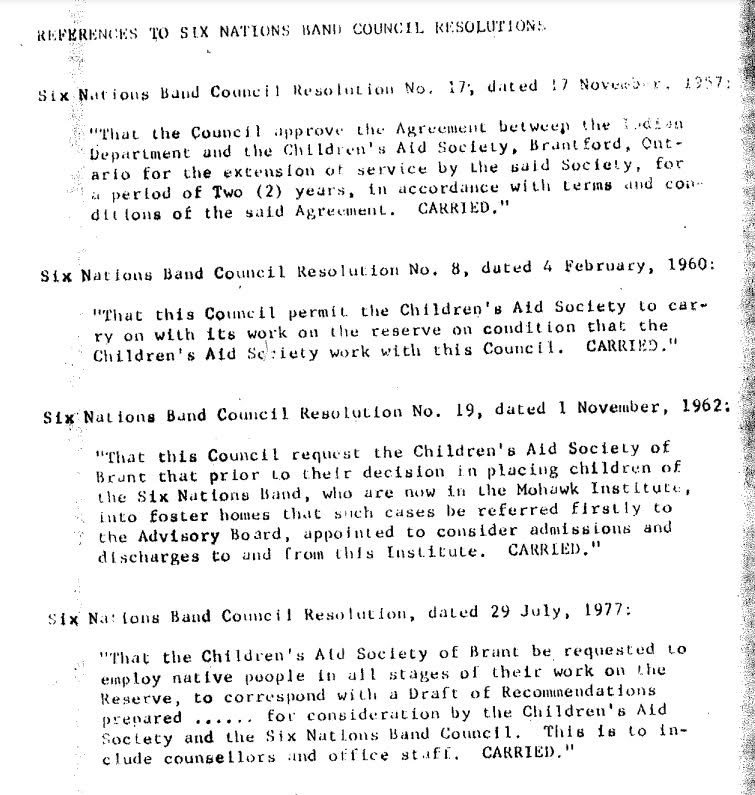
A typed page headed “References to Six Nations Band Council Resolutions”, taken from the Children’s Aid Society of Brant’s own website before the site changed, sets out four resolutions of the Six Nations Band Council on the Children’s Aid Society, from 1957 to 1977. They are the Council’s own words, given here as the page gives them, each one carried. The 1962 resolution speaks of children “now in the Mohawk Institute” being placed by the Society in foster homes.
The Nation reads them as the same program carried on by other hands: as the Institute’s years ran out, the taking of children from their families went on through the Society. That is the Nation’s reading of the record; the resolutions themselves are the Council’s.
- 17 November 1957 · Resolution No. 17
“That the Council approve the Agreement between the Indian Department and the Children’s Aid Society, Brantford, Ontario for the extension of service by the said Society, for a period of Two (2) years, in accordance with terms and conditions of the said Agreement. Carried.”
- 4 February 1960 · Resolution No. 8
“That this Council permit the Children’s Aid Society to carry on with its work on the reserve on condition that the Children’s Aid Society work with this Council. Carried.”
- 1 November 1962 · Resolution No. 19
“That this Council request the Children’s Aid Society of Brant that prior to their decision in placing children of the Six Nations Band, who are now in the Mohawk Institute, into foster homes that such cases be referred firstly to the Advisory Board, appointed to consider admissions and discharges to and from this Institute. Carried.”
- 29 July 1977 · Resolution, no number given
“That the Children’s Aid Society of Brant be requested to employ native people in all stages of their work on the Reserve, to correspond with a Draft of Recommendations prepared …… for consideration by the Children’s Aid Society and the Six Nations Band Council. This is to include counsellors and office staff. Carried.”
Where it comes from, and what is still openThe page was taken from the Children’s Aid Society of Brant’s website before the site changed; that page is no longer there, and who typed it, and for what report, is not stated on it. The resolutions have not yet been checked against the Council’s own minutes. The number and date of the 1957 resolution are read from a faint copy. The dots in the 1977 resolution are the page’s own: something was left out where it was typed.
The page itself, as it was kept from the Children’s Aid Society of Brant’s website: a typed list of the four resolutions, each with its number and date above it and its words in quotation marks below.
the children’s name for it
Why the Mush Hole
The children called the Institute the Mush Hole, for the food: the name they gave it is the name this site keeps beside its own. What they lived there is told best in their own words.
Elizabeth Graham’s The Mush Hole (1997) gathers survivors’ accounts of the Institute in one book. The Woodland Cultural Centre, the National Centre for Truth and Reconciliation and the Six Nations Survivors’ Secretariat keep what survivors have said since, and the work they lead: where the accounts are kept.
In their own wordsElizabeth Graham, The Mush Hole (1997): survivors’ accounts of the Institute, gathered in one book
a critic would ask
A question here
Why is a residential school among the Nation’s promises?
Because it was opened under the promise of a school, and that is the first thing the Nation means to say about it: what was promised was not what was given.
One of the four questions an expert or critic would ask, from Book VIII, The School; all four.