From the Mush Hole to a site of conscience
The building today
The community was asked whether to pull the building down or keep it. The answer was to keep it, as evidence.
From Book VIII, The School, the building today.
Checked against Book VIII on 21 November 2026 · about 4 minutes to read
1972 to now
Woodland, and Save the Evidence
Two years after the school closed, in 1972, the Woodland Cultural Centre opened in it, to keep and teach the languages, the art and the history of the Haudenosaunee and the Anishinaabe. When the building began to fail, the Centre asked the community whether to pull it down or keep it; the answer was to keep it, as evidence.
The Save the Evidence campaign followed, and raised the whole of its $23.5 million budget for the restoration. The restored building is to open as a site of conscience, where a visitor walks through what the children lived; a new cultural centre is planned beside it.
| What | Where it stands |
|---|---|
| The Woodland Cultural Centre | Opened in the building in 1972 |
| Save the Evidence | The restoration, fully funded at $23.5 million |
| The children’s writing | Found during the restoration, and kept |
| A site of conscience | The 1904 building, restored, to be walked through |
| A new cultural centre | A further campaign, Acknowledging Our Story, to house its collections |
kept where it was
The writing on the walls
Workers found the children’s own writing on the walls during the restoration, from as early as the 1900s, and kept it where it was.
How to read the drawing: a brick wall with faint scratched marks, standing for the children’s writing kept on the walls. It is shown here only as marks; the words are theirs, and they are kept in the building.
Mohawk Street
The walk to the chapel
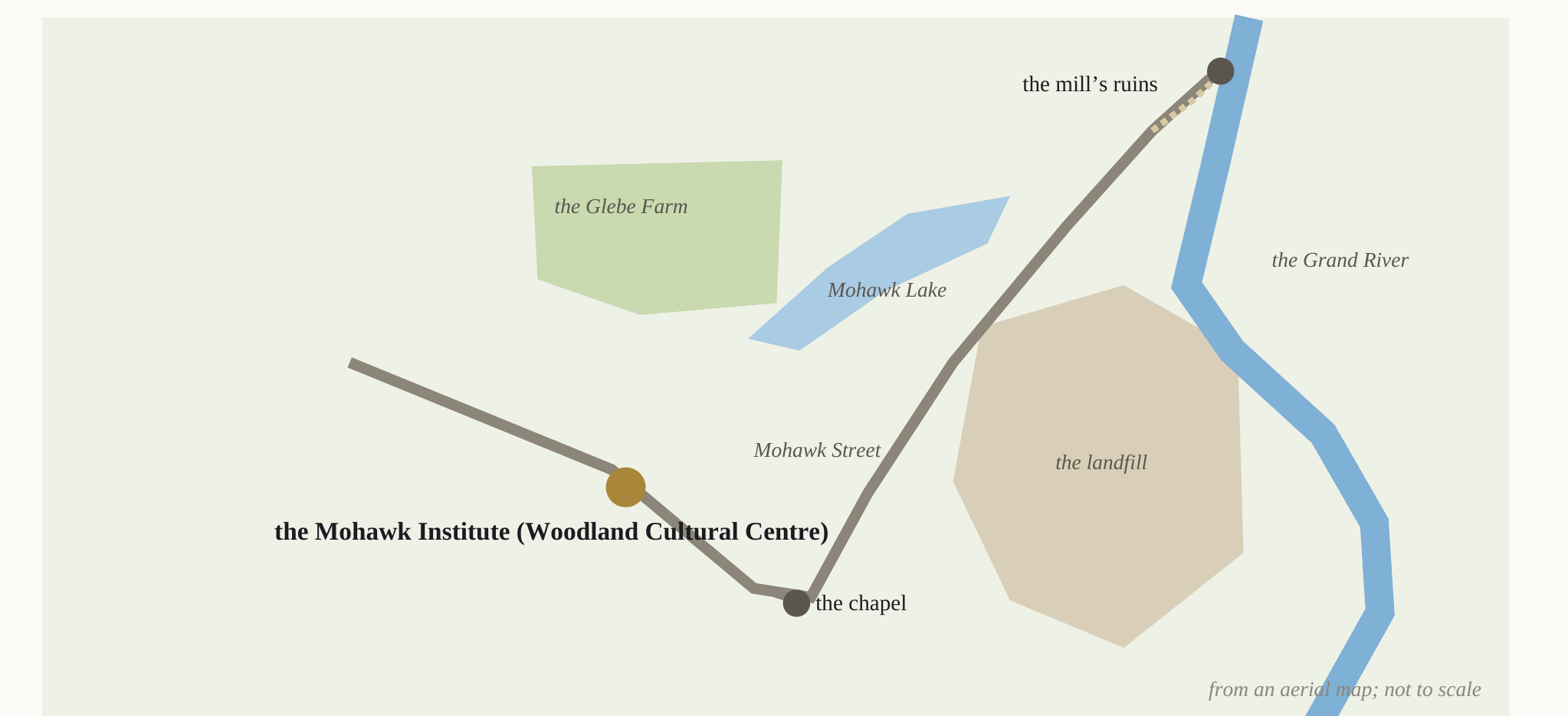
The Institute stood on the land of the old Mohawk Village. His Majesty’s Royal Chapel of the Mohawks is a short walk south-east along the same street: the walk the children made on Sundays. Mohawk Street runs on north-east between Mohawk Lake and the landfill to the river and the mill’s ruins; the Glebe Farm lies north of the lake.
How to read the drawing: the ground of the old Mohawk Village, drawn from an aerial map and not to scale. The Mohawk Institute, now the Woodland Cultural Centre, picked out in gold, stands on Mohawk Street at the left; the chapel is a short walk south-east along the same street; the street runs on between Mohawk Lake and the landfill to the river and the mill’s ruins. Tap a round mark to go to that place.
the Institute · this pagethe chapel · mohawkchapel.orgthe mill’s ruins · the third promise
184 Mohawk Street
Visiting
The Woodland Cultural Centre is at 184 Mohawk Street, Brantford, a short walk west of the chapel. Tours of the restored building are guided; check the Centre’s own notices for days and times before going, and go with time to sit afterwards.
Where184 Mohawk Street, Brantford; a short walk west of His Majesty’s Royal Chapel of the Mohawks
ToursGuided; check the Woodland Cultural Centre’s own notices for days and times
AfterwardsGo with time to sit
in their own words
Where the survivors’ own accounts are kept
This site does not speak for the survivors. These are the places that keep what they have said, and the work they lead.
| Where | What it holds |
|---|---|
| The Woodland Cultural Centre | The building, its archive and its survivors’ programmes |
| The National Centre for Truth and Reconciliation, Winnipeg | Survivors’ statements and the schools’ records, nationally |
| The Six Nations Survivors’ Secretariat | The ground search and the survivors’ own work |
| Elizabeth Graham, The Mush Hole (1997) | Survivors’ accounts of the Institute, gathered in one book |
71 to 76
The missing children: the Calls to Action
The Truth and Reconciliation Commission’s Calls to Action 71 to 76 set the standard for the missing children and the burials: the records, the searches, and the families’ say.
- 71Every coroner and records office to give the National Centre their records of the deaths of children in the schools
- 72A national register of the children who died at the schools, kept by the Centre
- 73An online register of the schools’ cemeteries, with maps of where children are buried
- 74Families told where their children lie, and their wishes for them respected
- 75The cemeteries found, documented, kept and protected, with the families and the communities leading
- 76Those doing that work to let the community lead, to hear survivors and knowledge keepers first, and to respect privacy
a critic would ask
A question here
Why keep the building at all?
The survivors and the community were asked, and chose to keep it as evidence. A building that is gone can be denied; one that stands cannot.
One of the four questions an expert or critic would ask, from Book VIII, The School; all four.