The Secretariat’s record
The Nation’s record
What the Secretariat’s office did about the Institute, and when, as its papers show. Where others made findings, this page says whose they are.
From Book VIII, The School, the Nation’s own record.
Checked against Book VIII on 21 November 2026 · about 14 minutes to read
1995 to 2021
What the office did
The Secretariat’s office has acted on the Institute more than once, and keeps the papers. In 1995 and 1996 it was part of an effort to bring the residential schools before the International Court of Justice as genocide, under a memorandum agreement with the Six Nations Elected Council; the case did not go ahead, and the answer given since has been that the matter is handled at home. The Secretary-General holds that it belongs at the World Court, and that the Council withdrew its support in 2010 when findings at the Institute pointed toward criminal consequences.
On 12 April 2011 the office, under Secretary-General Arnold Douglas, issued a mandate under the Nation’s seal for an investigation at the Institute; a ground-penetrating radar survey followed on 28 September 2011, reported on the front page of Tekawennake on 12 October 2011. The mandate is recorded because it shows the office acting, under its own seal, as the authority that began the work. Findings that others reported from that work are theirs, and some are disputed; the Nation does not vouch for them.
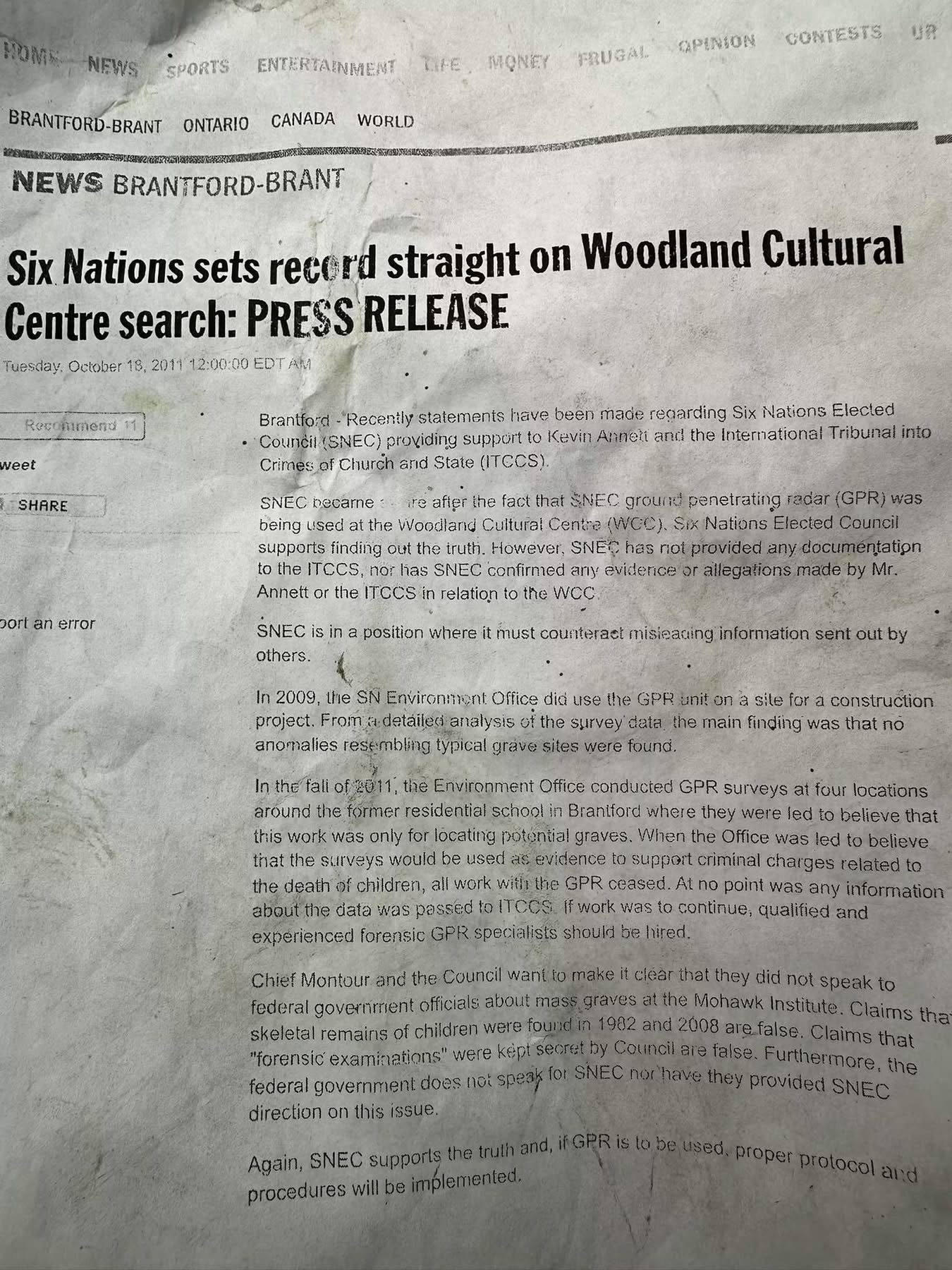
On 18 October 2011 the Six Nations Elected Council, under Chief Montour, put out a press release, carried on the Brantford Expositor’s website, headed “Six Nations sets record straight on Woodland Cultural Centre search”. In it the Council says that its Environment Office had carried out radar surveys at four places around the former school that fall, believing the work was only to locate possible graves, and that “when the Office was led to believe that the surveys would be used as evidence to support criminal charges related to the death of children, all work with the GPR ceased.” It says no information about the data was passed to the International Tribunal into Crimes of Church and State, whose statements it was answering. It says that an earlier survey, in 2009, on a site for a construction project, found “no anomalies resembling typical grave sites”, and it calls false the claims that children’s remains were found in 1982 and 2008. All of that is the Council’s own statement, recorded here as theirs; what it denies is recorded as disputed.
The press release as it was printed from the Brantford Expositor’s website, its Brantford-Brant news page: its headline, its date of Tuesday, 18 October 2011, and its seven paragraphs in the Council’s own words. It is cleaned for reading, the creases and marks of the kept page evened out and the page set straight, with nothing written on it changed; the photograph as it was taken is kept beside it.
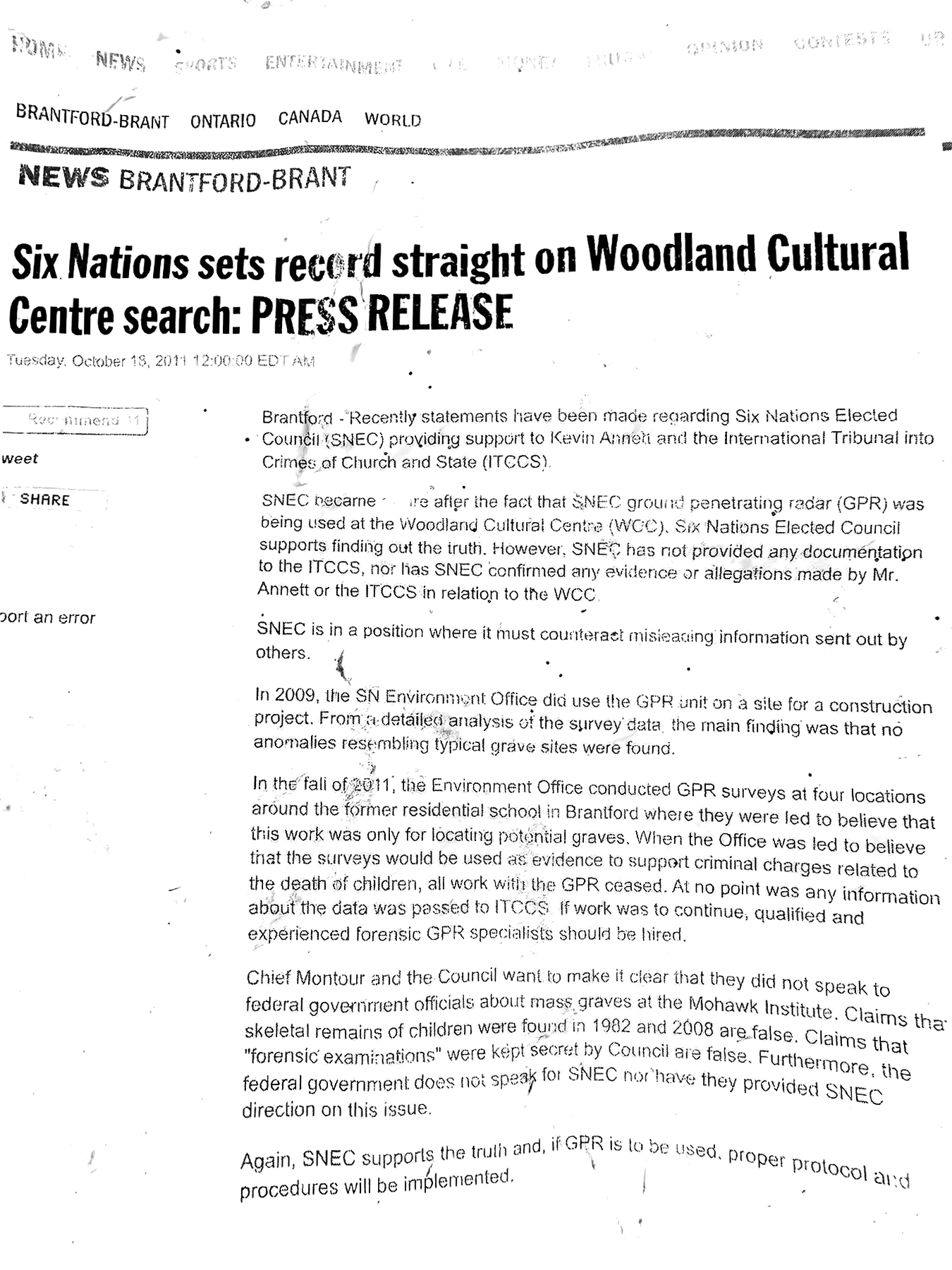
The Secretary-General holds that the release marks the end of the Council’s help with the investigation the office’s mandate had begun: the work stopped, and the data was not shared. That is the office’s account.
Ten years on, in June 2021, the Council’s elected chief, Mark Hill, wrote an open letter to the Prime Minister and his ministers asking for ground-penetrating radar to search the whole of the Institute’s grounds, and told CBC News: “what we’re calling on is a criminal investigation.” If Ottawa did not provide the radar, he said, Six Nations would take on the search itself. In the same report the Woodland Cultural Centre’s director, Janis Monture, said large sections of the property had been searched over about ten years and no human remains found. (CBC News, June 2021.)
The Nation sets 2011 and 2021 side by side: in 2011 the Council stopped the radar work when it might support criminal charges; in 2021 the Council asked for radar and for a criminal investigation. That is the Nation’s reading; both statements are the Council’s own.
After the remains of 215 children were reported at the former Kamloops school in 2021, the Survivors’ Secretariat was established at Six Nations: survivor-led, to uncover, document and share the truth of the Mohawk Institute. Survivors wrote that July to the Six Nations police chief, Darren Montour, describing the abuse they suffered and alleging that staff were involved in students’ deaths. In November 2021 the Secretariat’s ground search began on more than two hundred hectares of the school’s former land, with community members and Six Nations police officers trained to run ground-penetrating radar, and a human rights monitor watching the work (CBC News). The federal government gave more than $10 million over three years for the search (CTV News), and Ontario a further $1.3 million in May 2022 (CHCH News). That search is Six Nations’ work, and the Register will carry what it chooses to publish.
The Nation counts it the third radar search: the Council’s own in 2009, whose site its release does not name; the surveys of 2011 that followed the Secretariat’s mandate; and the Survivors’ Secretariat’s from 2021. And it reads the order of things plainly: the Mohawk commissioned a criminal investigation under the Nation’s seal in 2011; ten years later the same inquiry was taken up by others, with millions behind it. That is the Nation’s reading; the figures are the reports’.
The Register’s rule
The Register records what the office did under its own seal as fact, what others found as theirs, and what is disputed as disputed.
1995 and 2011
The 1995 agreement, and what became of it
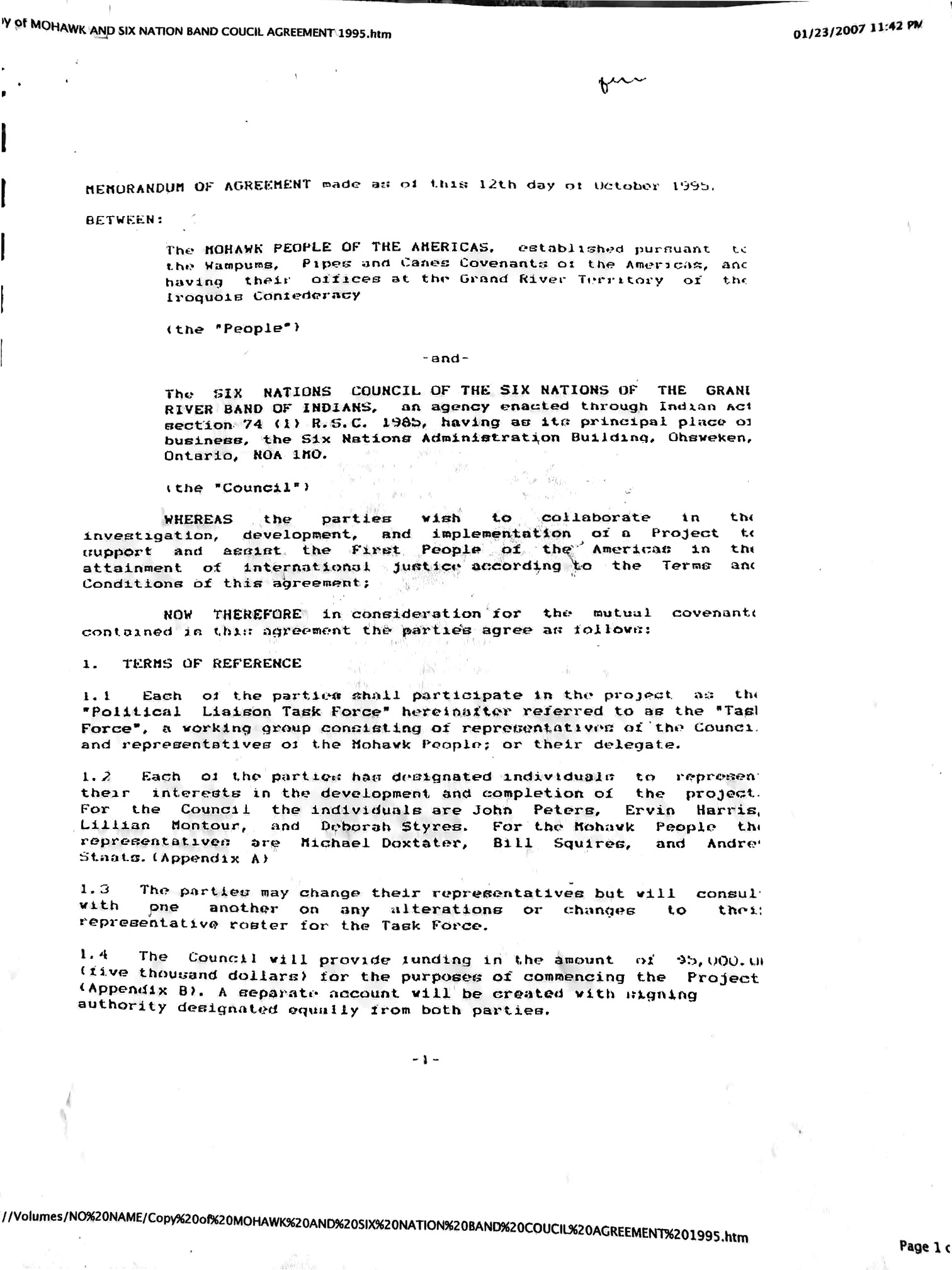
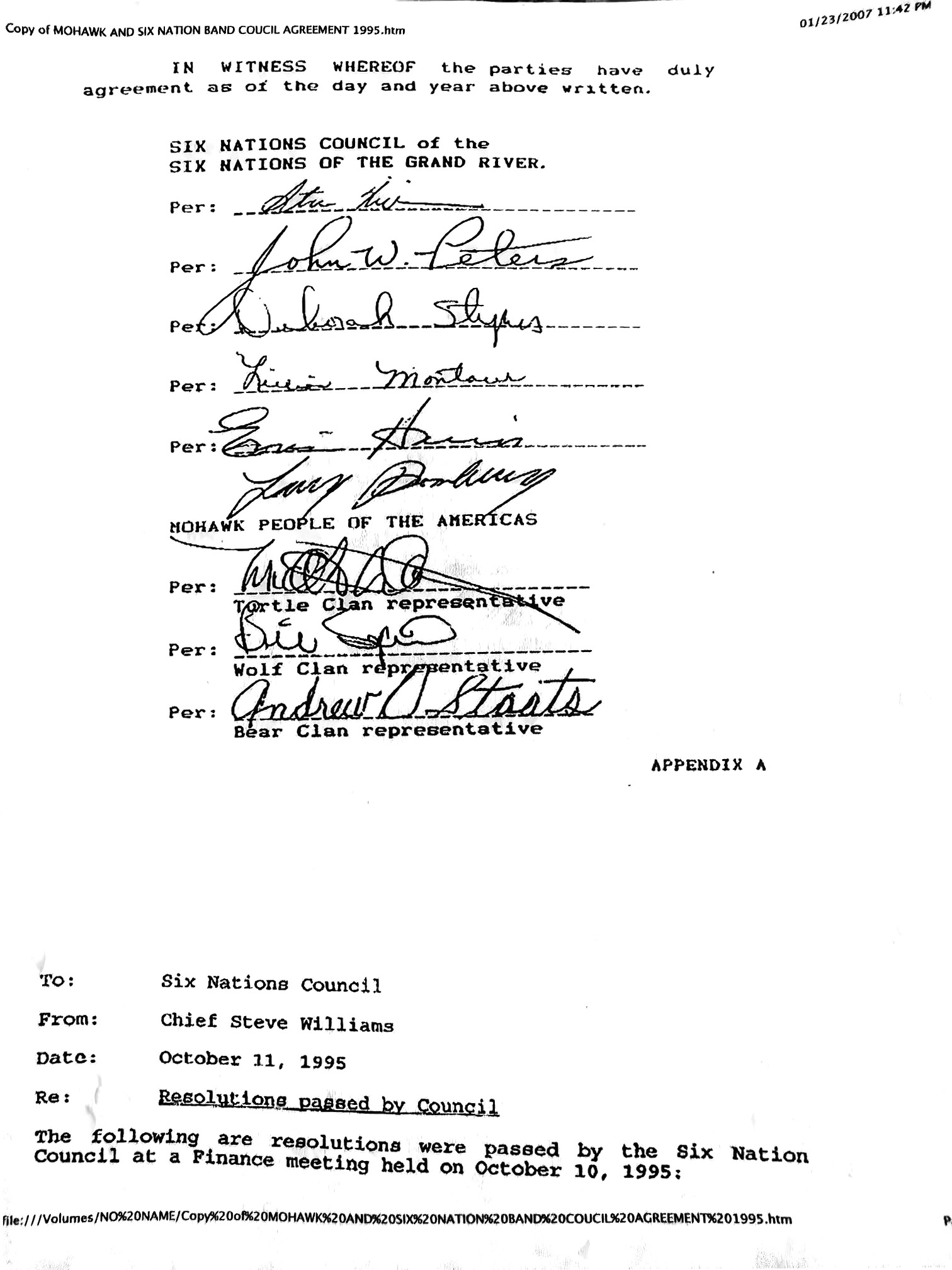
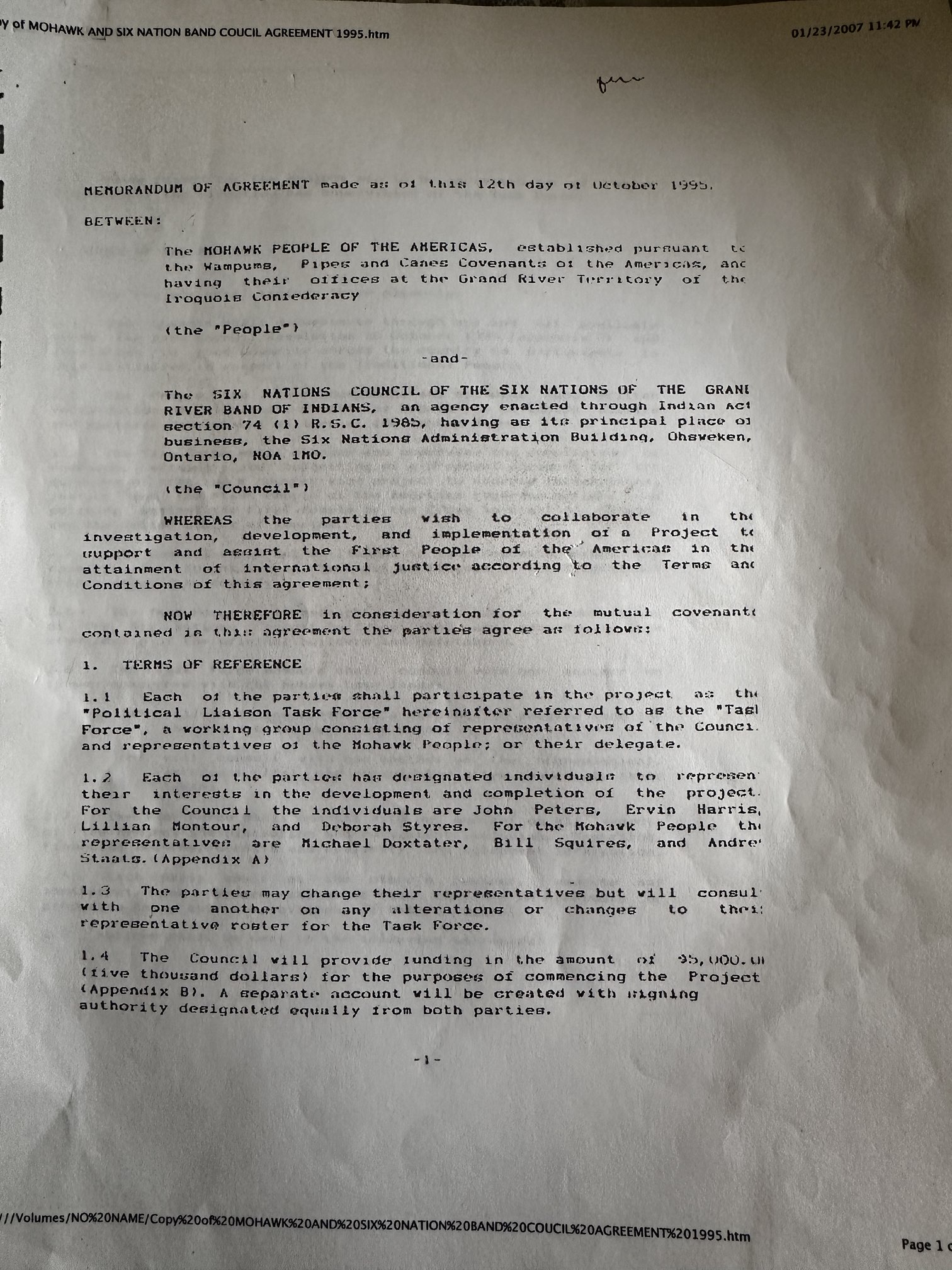
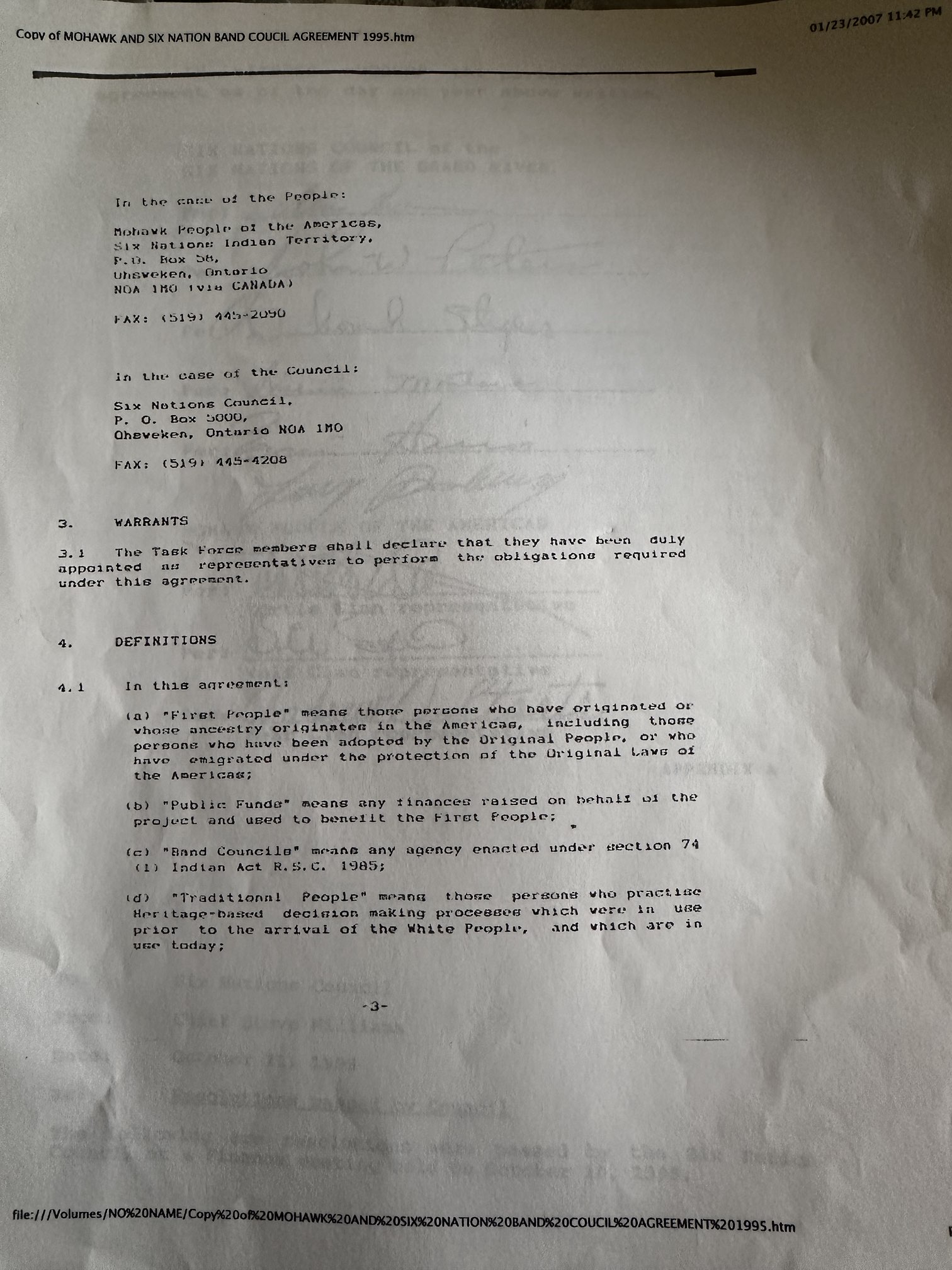
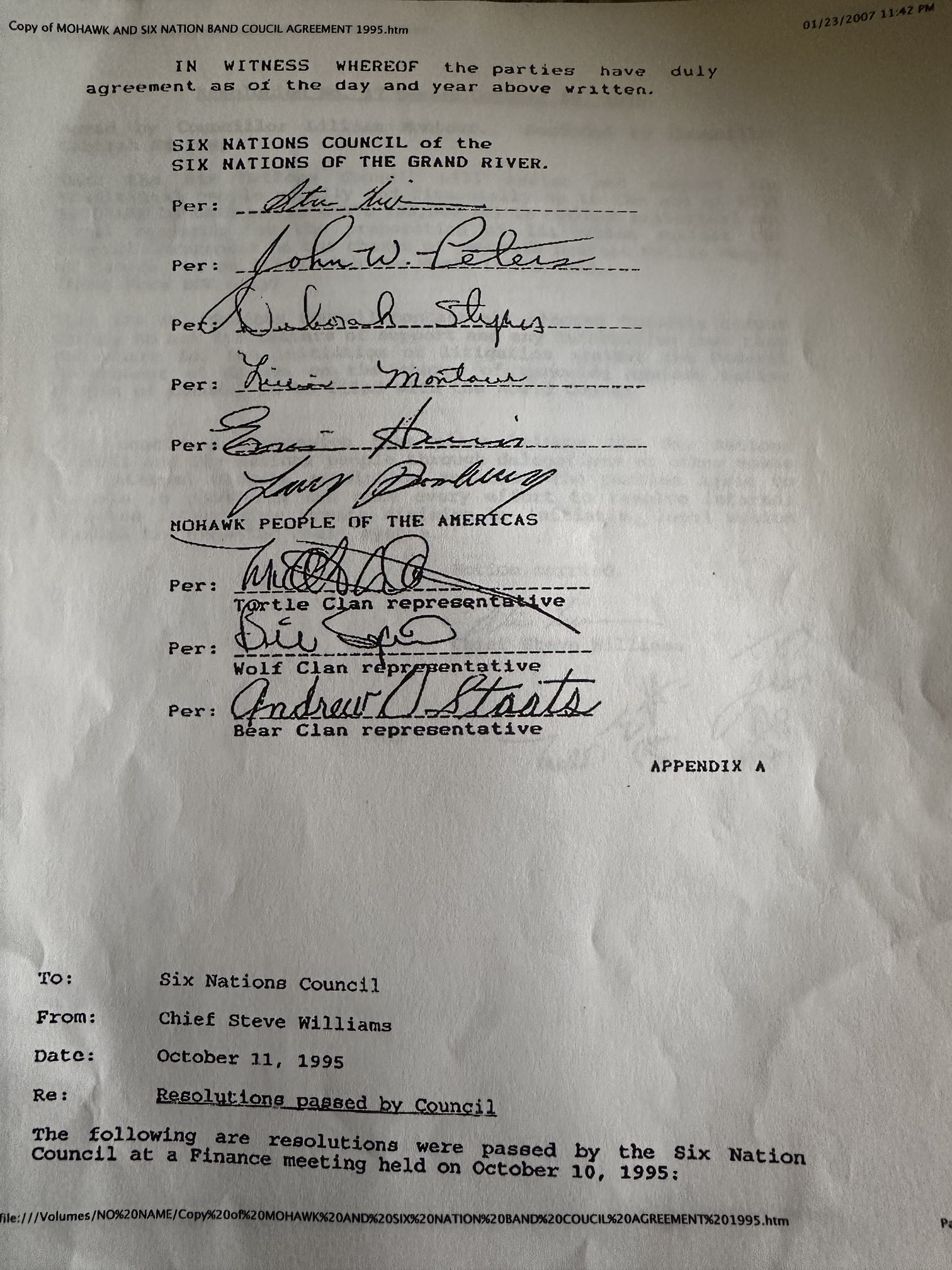
On 12 October 1995 a Memorandum of Agreement was made between the Mohawk People of the Americas, “established pursuant to the Wampums, Pipes and Canes Covenants of the Americas”, and the Six Nations Council of the Six Nations of the Grand River Band of Indians, which the agreement itself describes as “an agency enacted through Indian Act section 74 (1)”. Each named its people to a Political Liaison Task Force: for the Council, John Peters, Ervin Harris, Lillian Montour and Deborah Styres; for the Mohawk People, Michael Doxtater, Bill Squires and Andrew Staats, who signed as the Turtle, Wolf and Bear Clan representatives. Chief Steve Williams signed first for the Council.
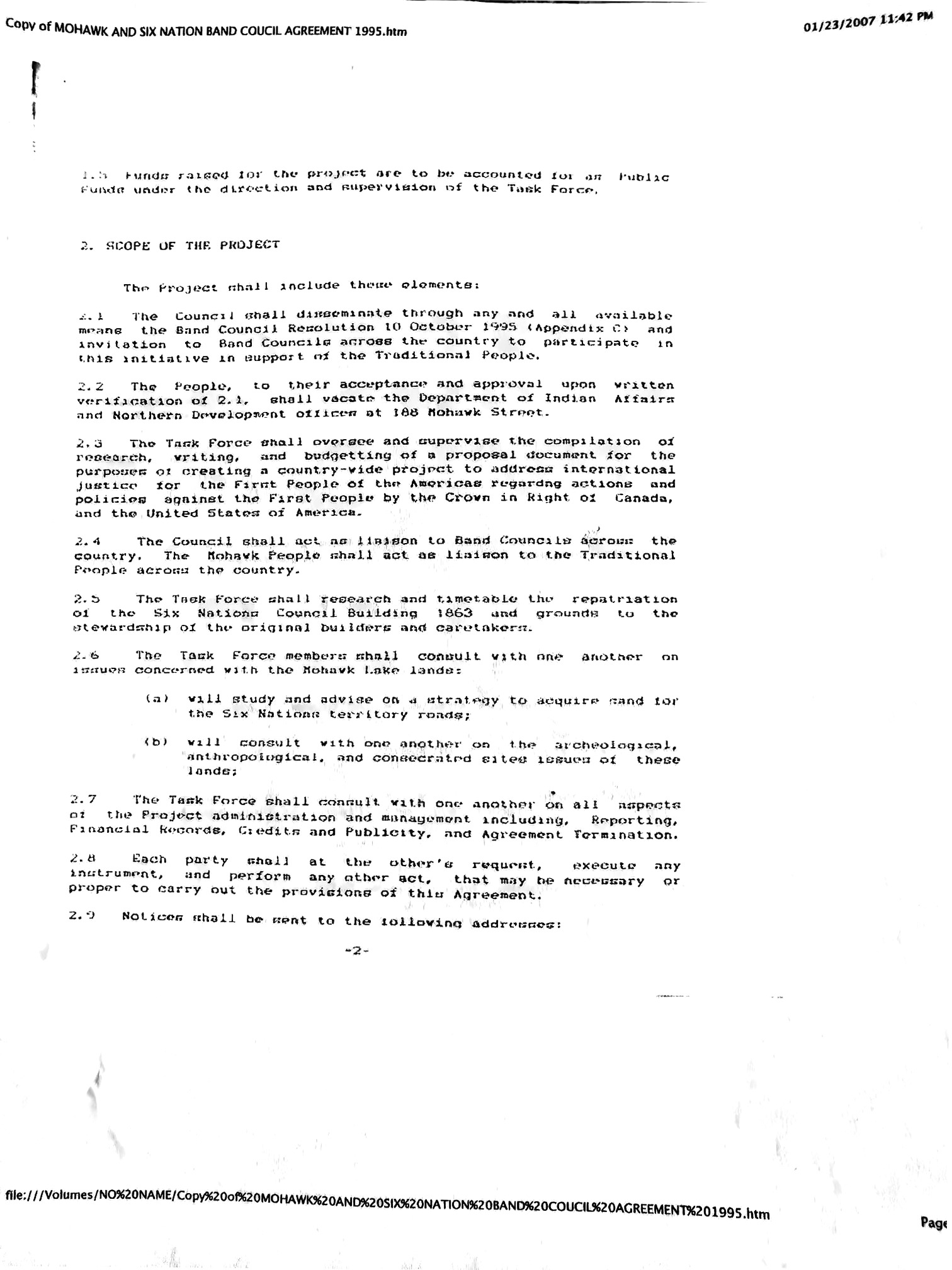
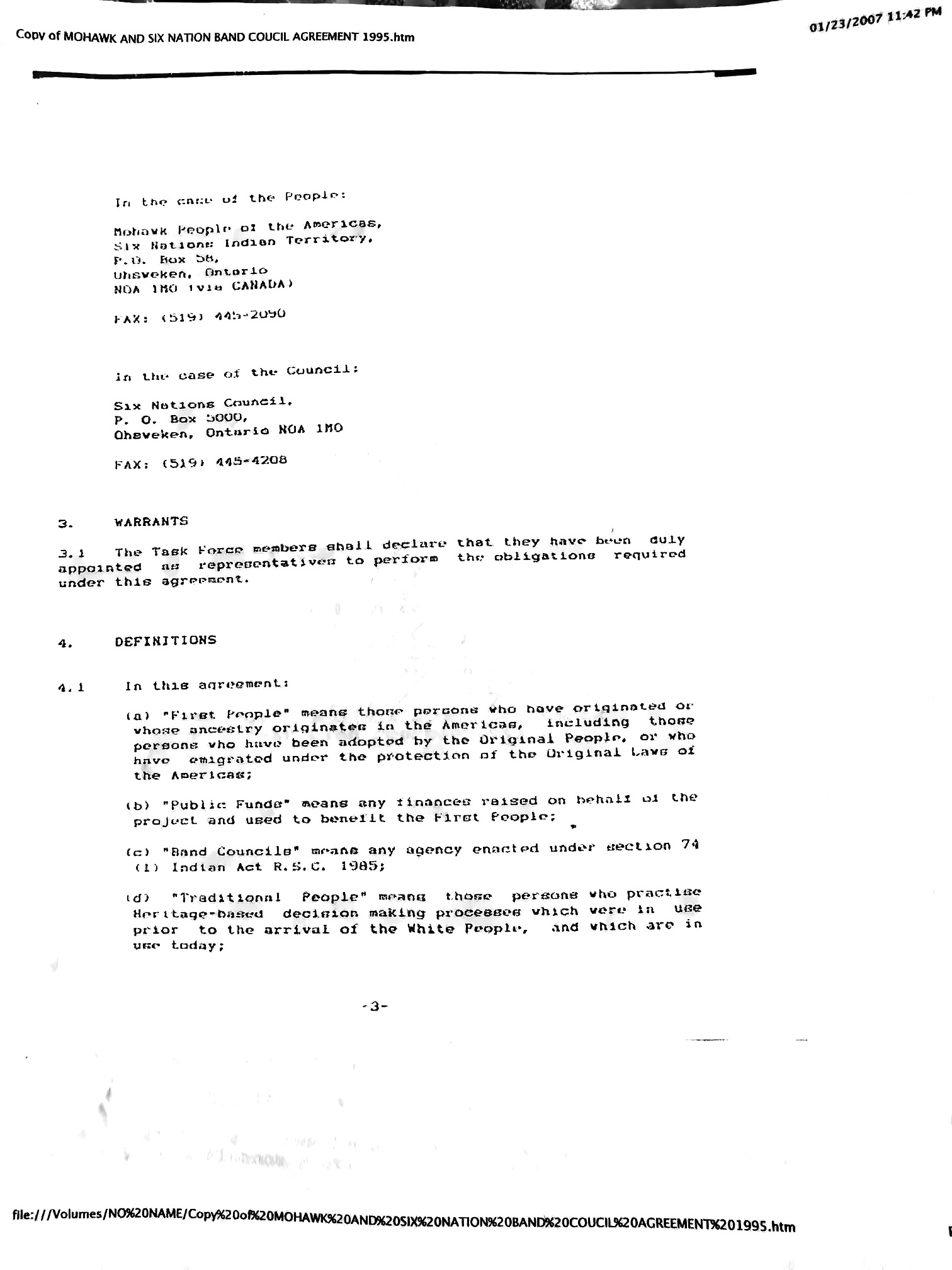
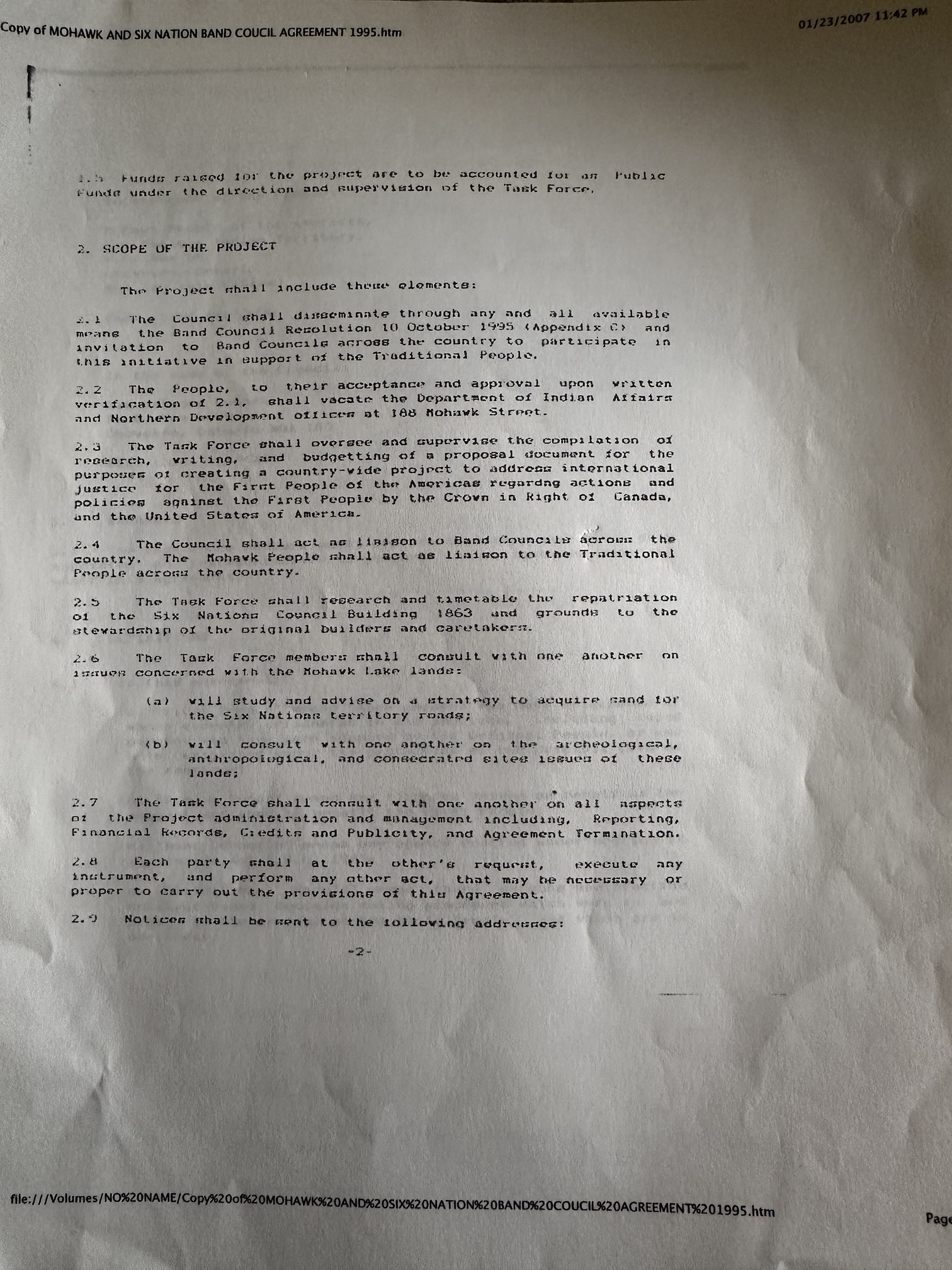
The project was “to support and assist the First People of the Americas in the attainment of international justice”. The Council was to send its resolution of 10 October to band councils across the country and invite them in; the Task Force was to prepare a country-wide project on international justice for actions and policies against the First People by the Crown in Right of Canada and the United States; the Council was to be liaison to the band councils and the Mohawk People to the traditional people; the Task Force was to work toward returning the Six Nations Council Building of 1863 and its grounds to the stewardship of its original builders and caretakers; and on the Mohawk Lake lands it was to advise on a way to get sand for the territory’s roads and consult on the archaeological, anthropological and consecrated sites there. The Council put $5,000 toward it, in an account signed for equally by both.
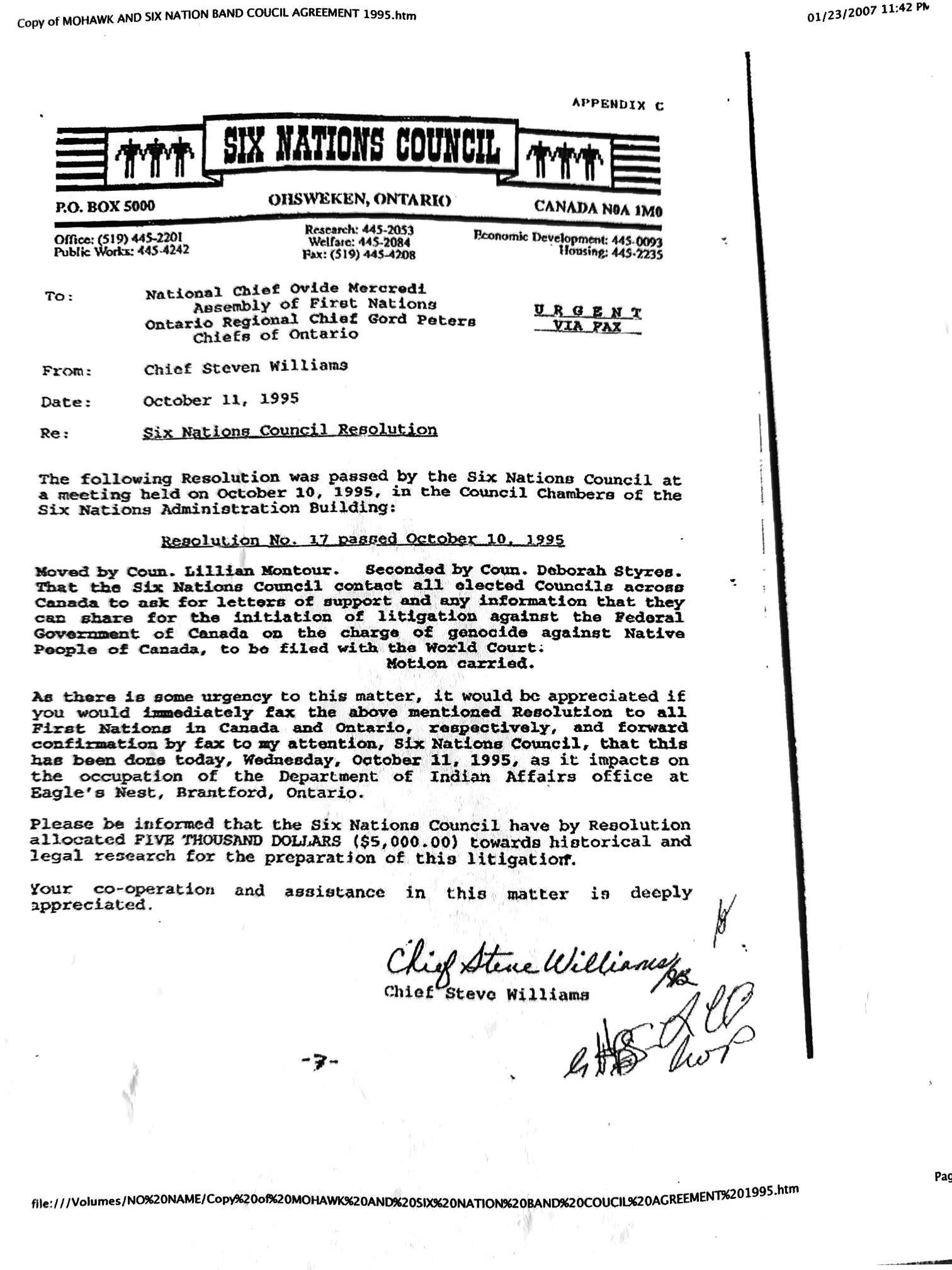
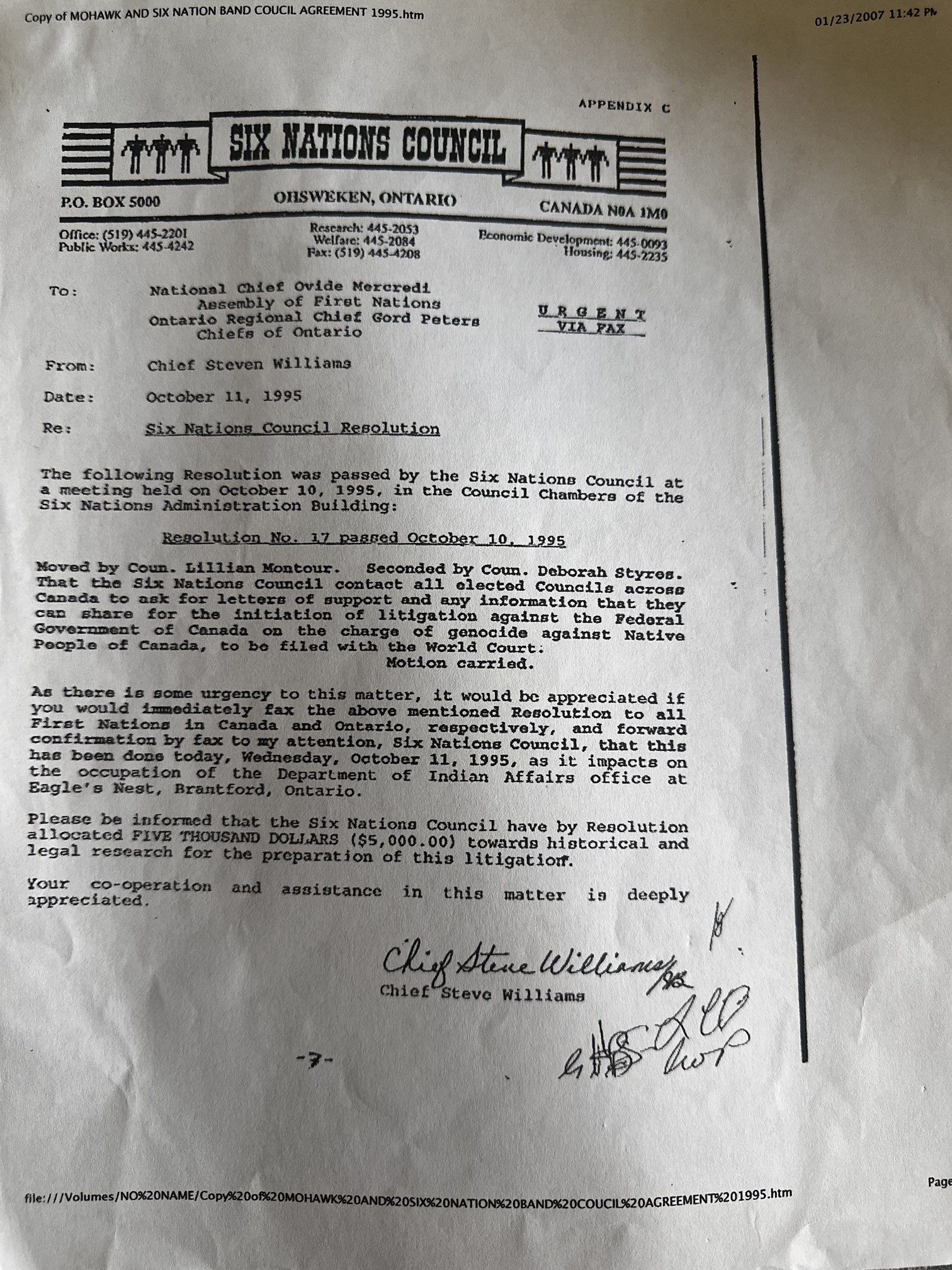
The agreement also records why it was made when it was: on written proof that the Council had sent out its resolution, the Mohawk People were to leave the Department of Indian Affairs offices at 188 Mohawk Street, which they were occupying. Chief Williams’s fax of 11 October asked the national and Ontario chiefs to send the resolution to every First Nation that day, “as it impacts on the occupation of the Department of Indian Affairs office at Eagle’s Nest, Brantford.”
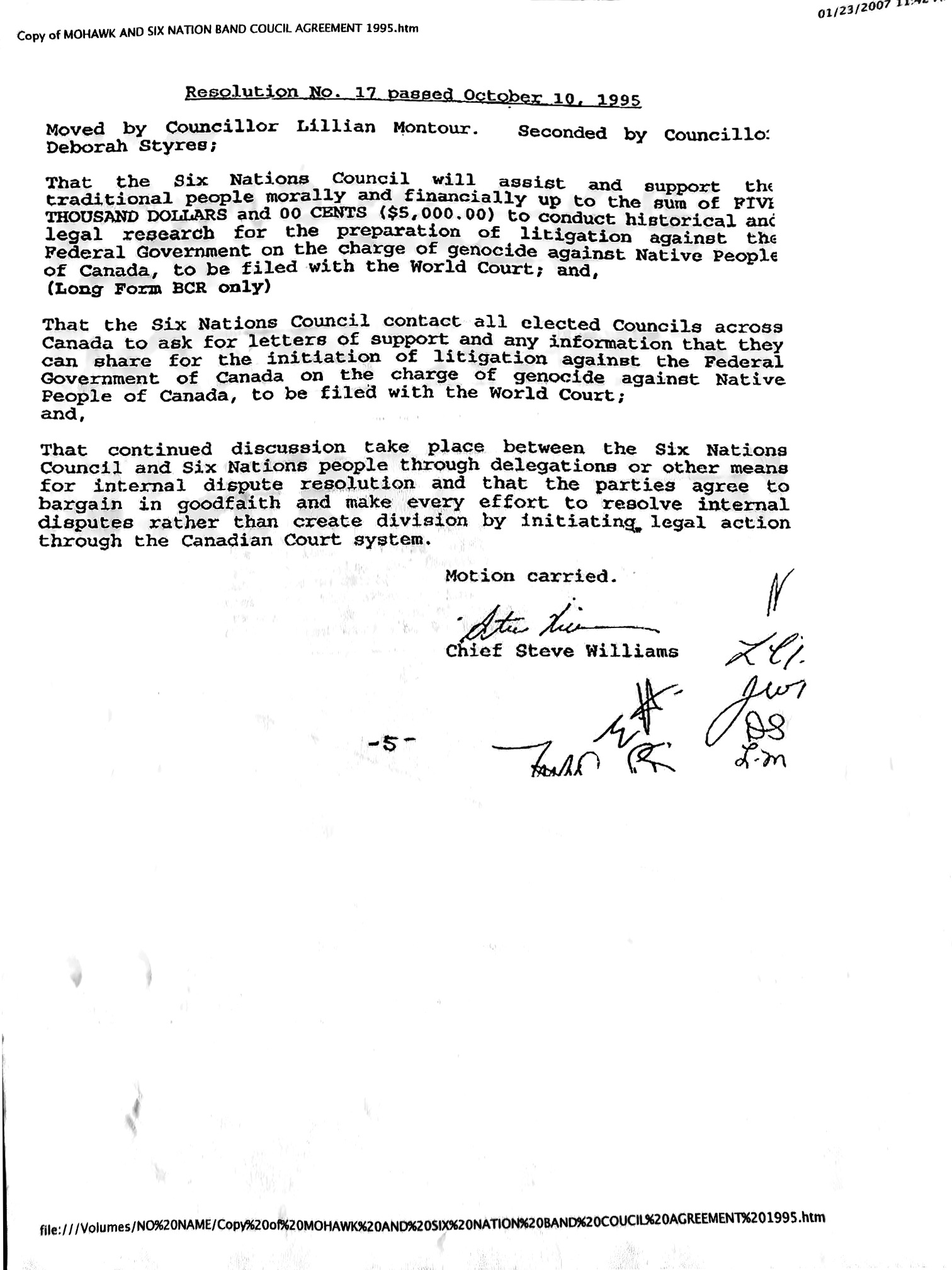
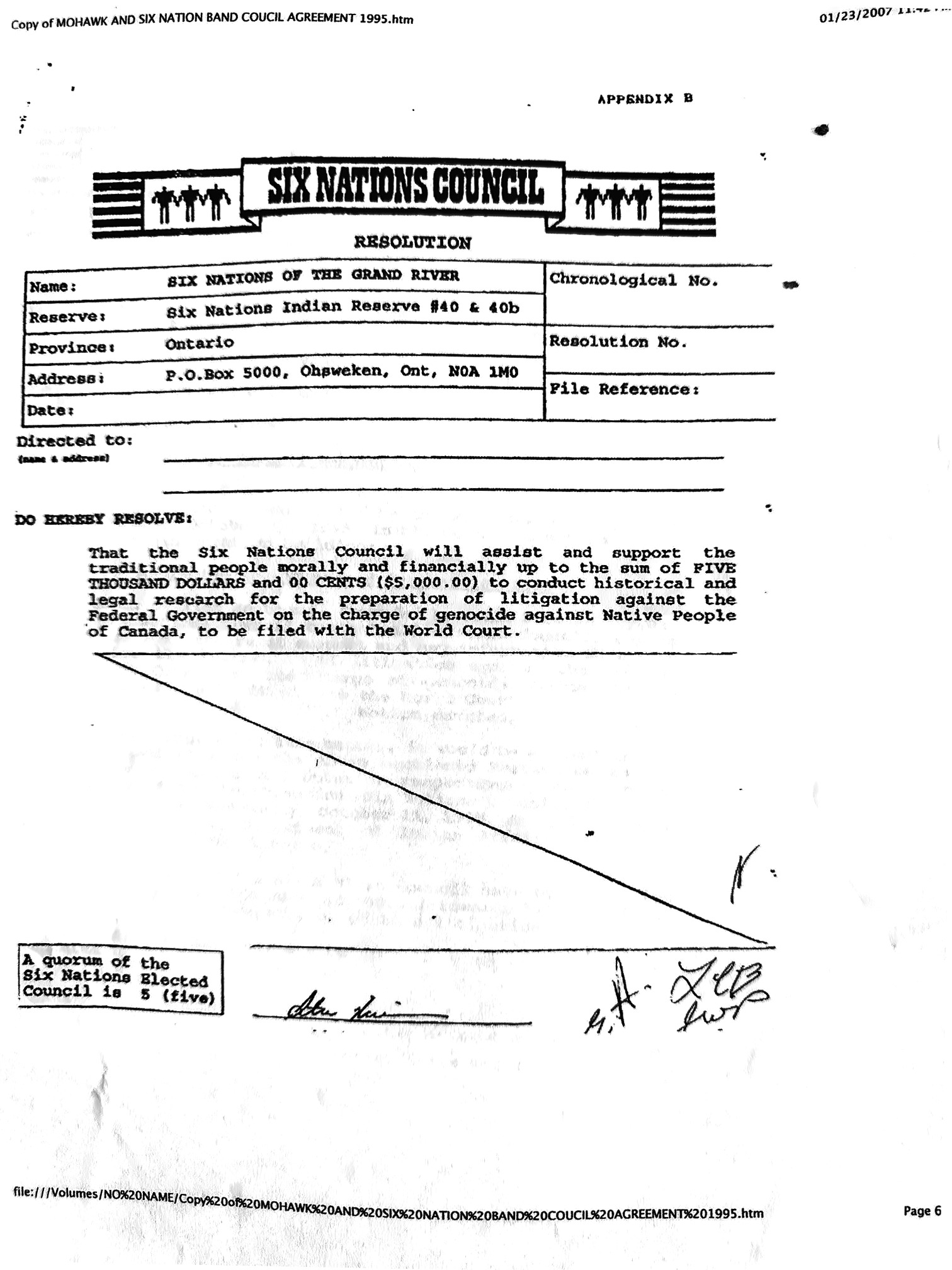
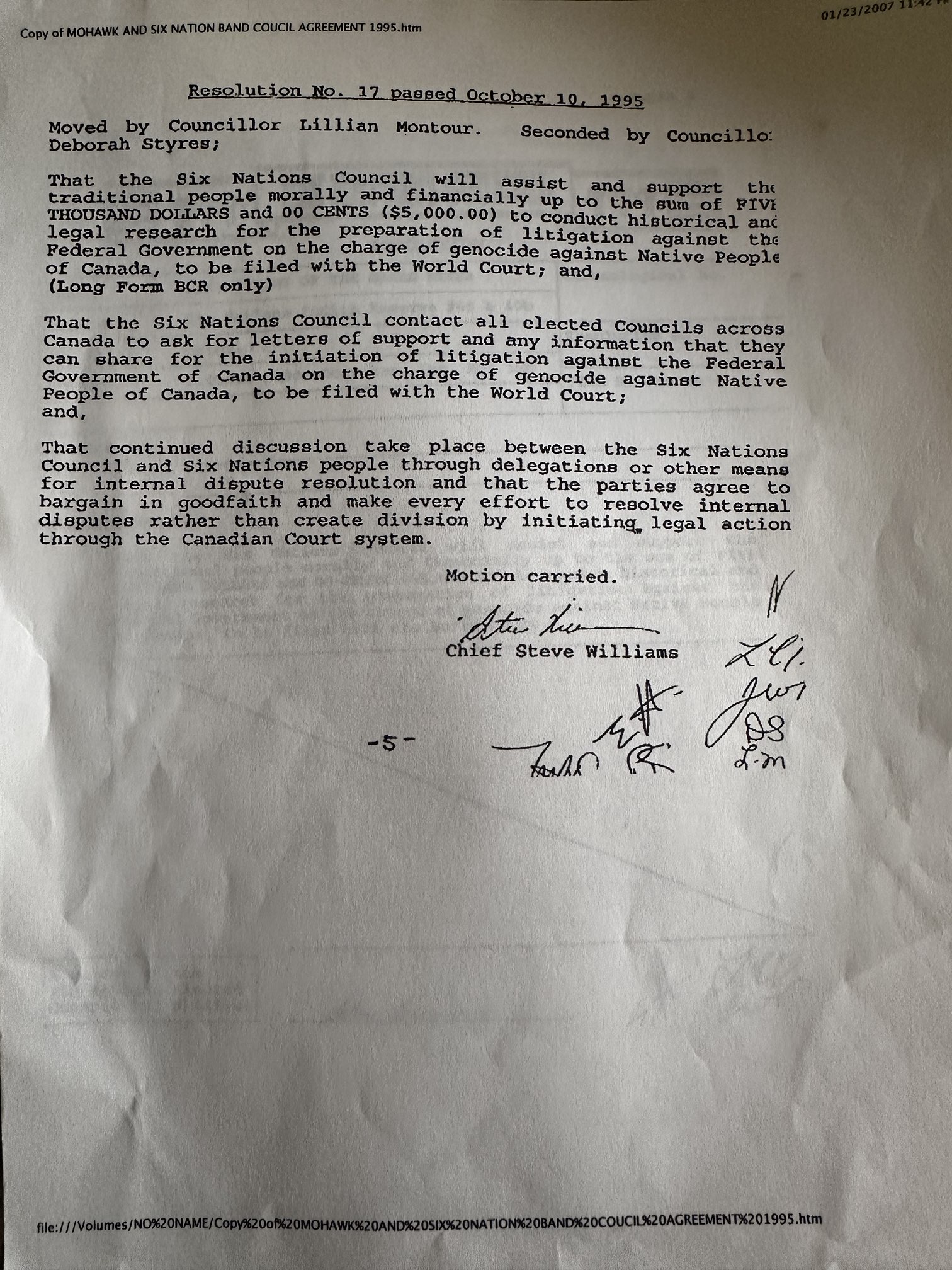
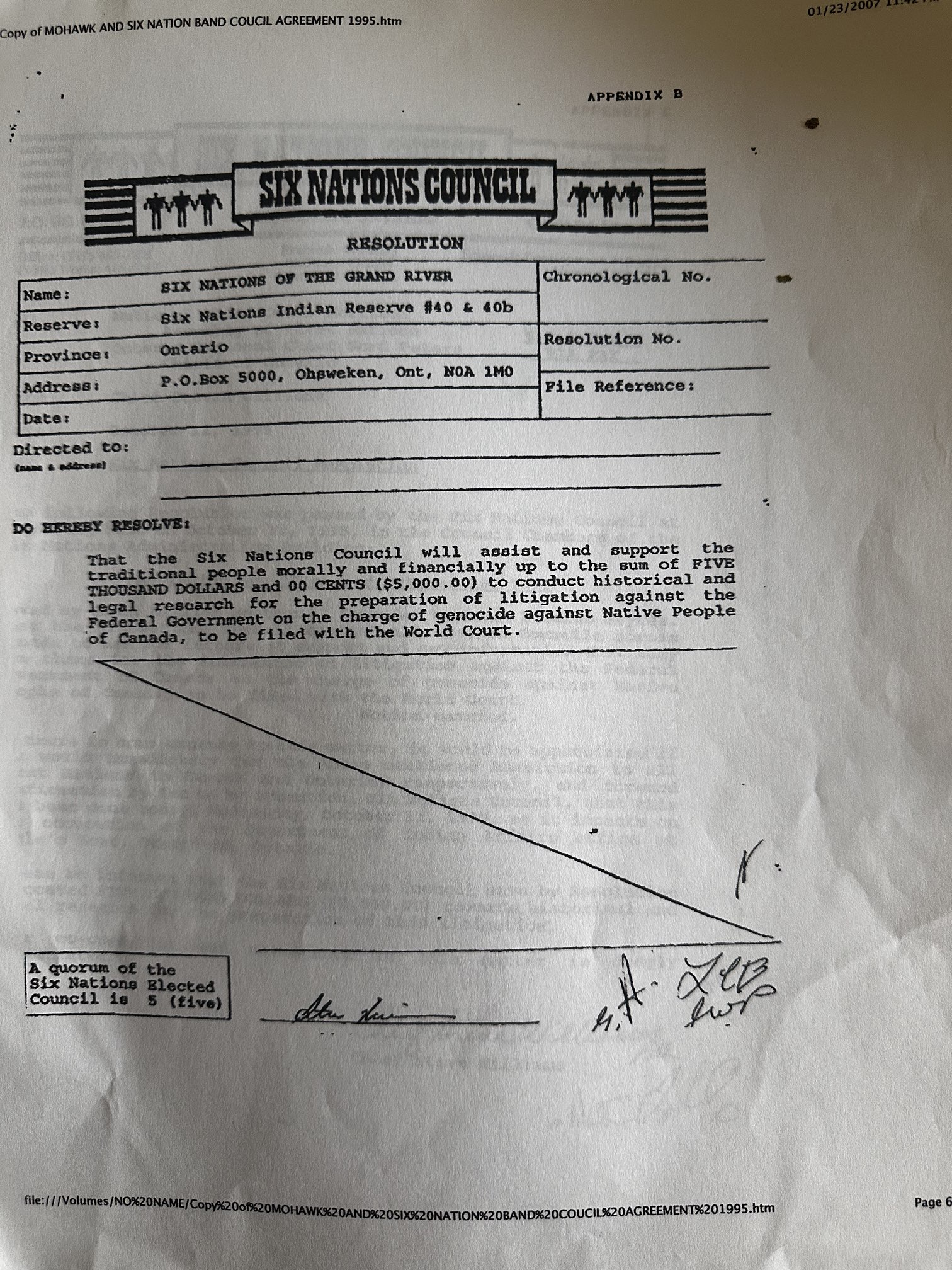
Resolution No. 17, moved by Councillor Lillian Montour and seconded by Councillor Deborah Styres, carried three things: that the Council would assist and support the traditional people “morally and financially up to the sum of five thousand dollars” for historical and legal research toward litigation against the federal government on the charge of genocide against Native people of Canada, to be filed with the World Court; that it would ask every elected council in Canada for letters of support; and that the Council and the Six Nations people would “make every effort to resolve internal disputes rather than create division by initiating legal action through the Canadian Court system.”
The sand and the graves had a history. A year before, on 15 October 1994, the Brantford Expositor reported that Mohawk traditionalists had begun occupying the Glebe lands because, they said, the Six Nations public works department had been digging into the graves of their ancestors for sand for icy roads. Bill Squires, who would sign the agreement for the Wolf Clan, told the paper: “We came here to make sure we know exactly what’s going on.” (David Young, “Mohawk traditionalists say stop misusing Glebe”, the Brantford Expositor, dated by hand 15 October 1994; a copy is kept on vitacollections.ca.)
Sixteen years after the agreement, the Council’s press release of 18 October 2011 ended the radar work at the Institute. The Nation reads the papers together: a council that once resolved, in writing and with money, to support a genocide claim at the World Court, and to keep internal disputes out of the Canadian courts, stepped back from the investigation that claim depended on, at the point it could have led to charges. And because no one makes an agreement with themselves, the Nation reads the 1995 agreement as the Council’s own acknowledgement that the Mohawk are a party of their own. Those are the Nation’s readings; the papers are the parties’.
The papers themselves, in the Secretariat’s copy: seven pages, printed on 23 January 2007 from a saved copy of the agreement, as the line at the top of each page shows. They are cleaned for reading: the creases and shadows of the paper evened out and each page set straight, with nothing written on them changed. Tap a page to open it full size; the photograph as it was taken is kept beside each.
Still to comeThe Record Codes for the agreement, the resolution and the fax, when they are entered on the Register.
In the papers
10 October 1995: “rather than create division by initiating legal action through the Canadian Court system.” 18 October 2011: “all work with the GPR ceased.”
the Nation’s position
Why the Mohawk still ask for an international remedy
The Nation’s position, in its own words: the 1995 agreement proves that the Mohawk and the Six Nations Council are not the same body, for no one makes an agreement with themselves. The Mohawk side has always pressed for remedies beyond Canada: at the World Court in 1995, and, by the office’s account, before the International Court of Justice in 1963 and 1964. The Council funded that effort in 1995, stepped back from the investigation in 2011, and in 2021 turned about and called for a criminal investigation itself. The Nation holds that a record which turns this way, on a matter this grave, is dangerous to the survivors and the families, and is the reason the Mohawk still ask for the matter to be put to an international forum as crimes against humanity.
The Nation holds that what was done at residential schools carries the elements of crimes that international law names. The International Criminal Court’s Elements of Crimes sets out what must be shown for each; these are the four the Nation points to.
- Forcibly transferring childrenGenocide, Article 6(e)
- What must be shown“The perpetrator forcibly transferred one or more persons”, under the age of eighteen, from a national, ethnical, racial or religious group to another group, with intent to destroy that group in whole or in part.
- Causing serious bodily or mental harmGenocide, Article 6(b)
- What must be shown“The perpetrator caused serious bodily or mental harm to one or more persons” of such a group, with the same intent.
- Forcible transfer of populationCrime against humanity, Article 7(1)(d)
- What must be shownPersons forced from where they were lawfully present, without grounds permitted under international law, as part of a widespread or systematic attack directed against a civilian population.
- Other inhumane actsCrime against humanity, Article 7(1)(k)
- What must be shown“Great suffering, or serious injury to body or to mental or physical health, by means of an inhumane act”, as part of such an attack.
Whether those elements are met in any case is for a court to decide, on evidence; the Nation’s case is that the question be put to one. That is the Nation’s position, stated as its own.
For the same reason, the Nation’s bills now before members of Parliament and of the Legislative Assembly ask Canada, and Ontario, to consent to binding arbitration of disputes over the Mohawk interest before the Permanent Court of Arbitration at The Hague, a tribunal of neither party, because no party should be judge in its own cause. Read the bills.
Can an international court hear it?
Not every court can. The International Criminal Court can try only acts done after its statute came into force on 1 July 2002, and the Mohawk Institute closed in 1970. The Genocide Convention has bound Canada since 1952, and disputes under it are heard by the International Court of Justice between states. That is why the Nation speaks of an international remedy, and of where it should be heard, as questions still to be answered; it does not claim that any court has taken the matter up.
whose each is
The record, in order
| Date | What the record shows | Whose |
|---|---|---|
| 10 October 1995 | Resolution No. 17: up to $5,000 for research toward a genocide claim against Canada at the World Court; internal disputes kept out of the Canadian courts | The Six Nations Council |
| 11 October 1995 | Chief Steve Williams circulates the resolution to the National Chief, the Ontario Regional Chief and the Chiefs of Ontario | The Six Nations Council |
| 12 October 1995 | The Memorandum of Agreement signed: a project for international justice; the Mohawk People to leave the occupied Indian Affairs offices at 188 Mohawk Street | The Mohawk People of the Americas, and the Six Nations Council |
| 2010 | The Council’s support withdrawn, by the Secretary-General’s account | The Elected Council |
| 12 April 2011 | The mandate for an investigation, under the Nation’s seal | The office, Arnold Douglas, Secretary-General |
| 28 September 2011 | A ground-penetrating radar survey | Those who carried it out |
| 12 October 2011 | Reported in Tekawennake | Jim Windle, reporting |
| 18 October 2011 | A press release: the radar work at the Institute ceased once the surveys might support criminal charges; no data passed on | The Six Nations Elected Council, Chief Montour |
| June 2021 | Chief Mark Hill calls for the whole Institute grounds to be searched as a criminal investigation, and asks Ottawa for ground-penetrating radar | The Six Nations Elected Council, Chief Mark Hill; reported by CBC News |
| 2021 | The Survivors’ Secretariat established at Six Nations, survivor-led | Six Nations, its Survivors’ Secretariat |
| November 2021 | A ground search of the Institute lands begins, with ground-penetrating radar | Six Nations, its Survivors’ Secretariat |
| 2021–22 | More than $10 million over three years from the federal government; $1.3 million from Ontario in May 2022 | The governments, as reported |
a critic would ask
A question here
Why does the Secretariat keep its own record of 2011?
Because it shows the office acting under its own seal, years before others did. The record proves the act, not every finding made afterward.
One of the four questions an expert or critic would ask, from Book VIII, The School; all four.